ETF Compass
Compare ETFs systematically and find the right products
Around 2,000 ETFs are traded on the Swiss stock exchange. VZ's ETF Compass allows you to find the products that suit your investment goals more quickly. Filter specifically by asset class, region, costs, benchmark, yield spread, tracking error, fund size, dividend policy, investment approach, currency hedging and replication method. Additional filters such as trading venue, provider or fund domicile make the selection process even easier. The ETF Compass is free of charge. Register now.
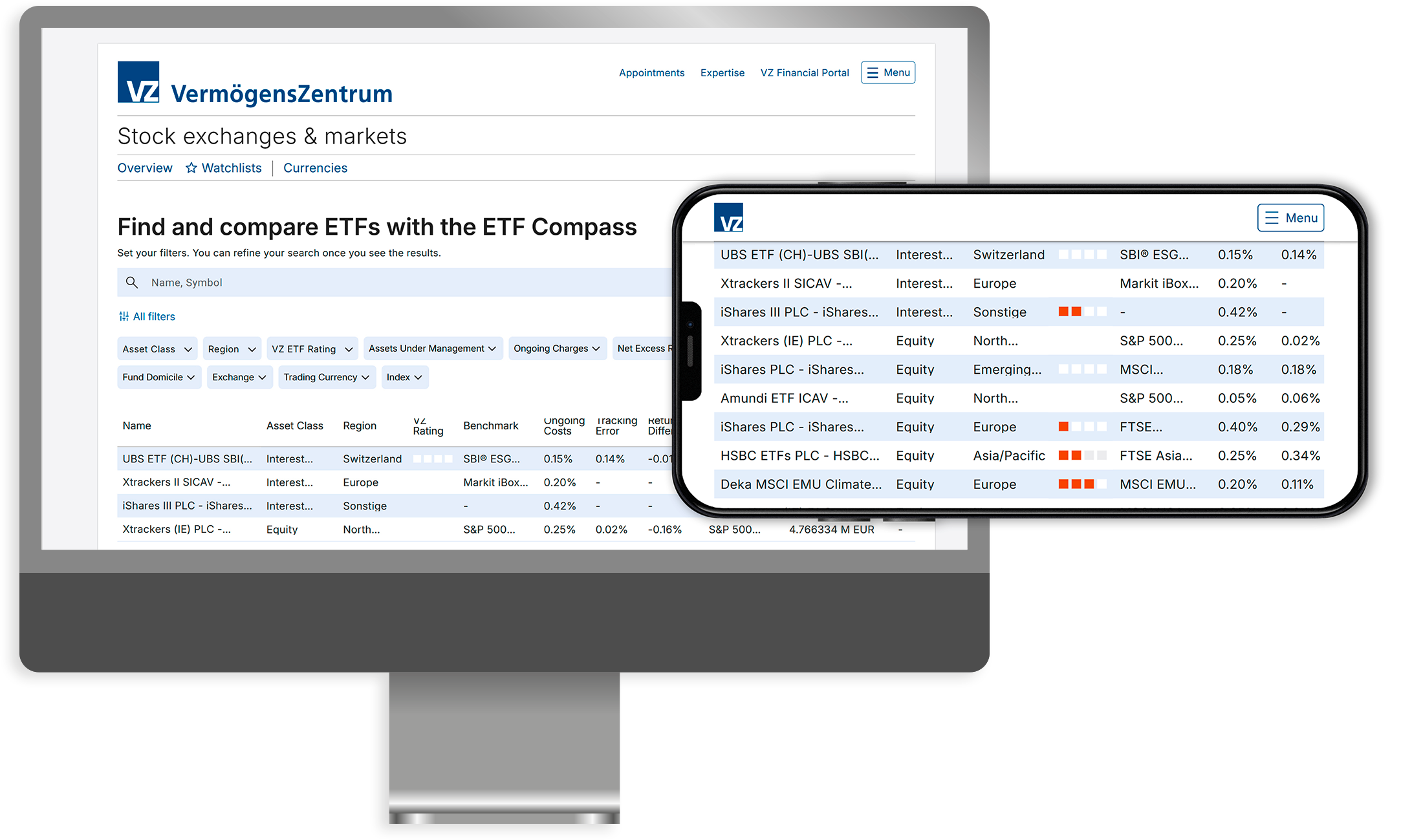
Thanks to the ETF Compass, you can quickly identify the differences between products and make more informed investment decisions. What's more, the VZ ETF rating assesses all ETFs traded on the Swiss stock exchange. This provides you with an independent guide to the quality of the various products and helps you choose suitable ETFs.
Do you have any questions about the ETF Compass?
-
What criteria can I use to filter and compare ETFs?
The ETF Compass offers a wide range of comparison options with criteria such as asset class, region, total costs, benchmark, yield spread, tracking error, fund size, dividend policy, investment approach, currency hedging, replication method and other characteristics including trading venue, provider or fund domicile.
Asset and orientation
- Asset classes (e.g. equities, bonds, commodities, specialities, money market)
- Regions (ranging from worldwide to individual countries)
- Benchmark (the index against which the ETF is measured, e.g. SMI, DAX or S&P 500)
- Investment approach (passive index tracking or actively managed)
Cost and size
- Total expense ratio (TER)
- Fund size
Quality and deviations
- The VZ rating, which assesses the quality of all ETFs traded on SIX Swiss Exchange. It takes the following criteria into account: ongoing costs, yield spread, tracking error, replication method, trading fees and market makers.
- Yield spread compared with the benchmark
- Tracking error (the deviation of return fluctuations from the benchmark)
Income and currency
- Dividend policy (distribution or reinvestment of dividends and coupons)
- Currency hedging (hedging of exchange rate risks)
Implementation and framework conditions
- Type of replication (physical replication or synthetic via derivatives)
- Other criteria such as trading venue, provider, fund domicile and trading currency
-
Why can't I filter ETFs by theme?
There are an increasing number of thematic funds, focusing on topics such as artificial intelligence, longevity and robotics. These often disappear from the market again rather quickly. Especially when it comes to trending themes, prices often factor in a great deal of euphoria. If public interest in the theme wanes, providers sometimes decide to close the funds. VZ VermögensZentrum therefore advises against chasing trends. Find out more about the topic in this article on thematic equity funds (not available in English).
-
How many ETFs do I need in my portfolio?
That depends entirely on your investment profile and return expectations, and possibly also your market expectations. Just a few ETFs are usually sufficient, as they're often diversified products in their own right. If you're unsure, VZ VermögensZentrum can help you develop and implement your personal investment strategy.
-
I'm looking for an ETF tracking the SPI. How can I find one?
To find an ETF tracking the SPI, simply enter "SPI" in the ETF Compass search field. All products with the index in their name will then be displayed. However, the search may also return products that don't explicitly track the SPI. Another option is to open the index search field and then click on "SPI" in the drop-down menu. The third option is to click on "SPI" in the tiles for the various indices. In both the second and third case, your search will exclusively show all ETFs tracking the SPI.
-
The ETF Compass shows the ongoing fund costs. Are these costs factored into the performance figures?
The ETF Compass lists the ongoing costs as stated in the fund documents. In addition to the management fees, these also include the costs for advertising and distributing the product. They don't take other costs into account, such as transaction costs within the ETF. The only difference from the standard TER metric is that funds of funds also include the costs of the sub-funds they contain. The performance figures already take into account all ongoing fund costs. There's nothing else to deduct.
-
I've selected an index. All available funds are rated by VZ as inadequate. What should I do?
Depending on its composition, an ETF may be able to track an index with varying degrees of accuracy. This is what determines the VZ rating. Indices with a large number of competing ETFs tend to have better VZ ratings. It's therefore advisable to switch to another index within the same asset class if the rating is inadequate. If this isn't possible, it's worth checking whether, for example, the securities you're interested in are included in other indices.
-
Where can I buy a suitable ETF?
You'll need a custody account if you want to invest in ETFs. In the VZ Financial Portal, you can trade securities at attractive conditions. This naturally includes ETFs. If you don't have an account yet, sign up for free.
-
What's the best way to search for an ETF?
The ETF Compass offers a wide range of functions, but gives you the choice. You don't have to set all the criteria right from the start. For example, you can start your search using a few key criteria and narrow it down later.
-
Free first meeting
Appointment


-
We'll contact you
Contact

-
VZ Financial Portal
Offer