Investment advice: banks' major conflict of interest
Investments
Banks have strong incentives to recommend their own financial products to clients when providing investment advice. Yet in-house investment products reduce clients' returns and often cost them tens of thousands of francs in unnecessary fees over the years.

Daniel Weinmann
Position Investment Expert
25 September 2026
VZ conducted a study (not available in English) that analysed the custody accounts of around 6,000 investors and found that banks' own products account for a significant proportion of most portfolios. Banks' own products include those which the respective bank issues itself or, at the very least, markets under its own name. These are usually actively managed investment funds.
Saving and investing with ETFs
Fact sheet

The smaller the custody account is, the higher the proportion of in-house products. In custody accounts with a value of up to CHF 100,000, banks' own products account for about 60% of all financial products on average. However, even in portfolios ranging from CHF 750,000 to CHF 1 million, their share is still around 30%.
This is problematic for clients for two reasons:
- The fees for in-house products are, on average, more than 40% higher than those for comparable third-party products. The higher costs directly erode the return and make it almost impossible to achieve a higher return than that offered by cheaper third-party alternatives.
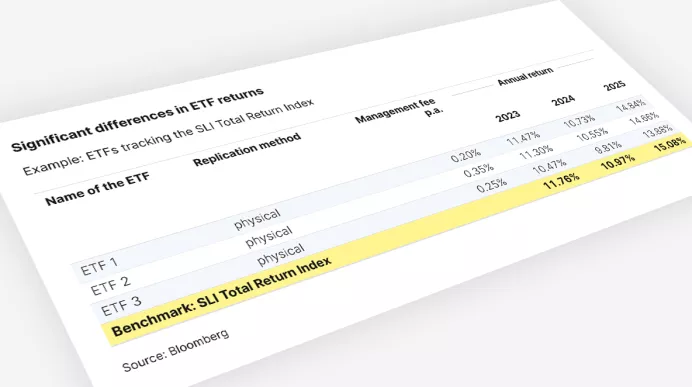
- Actively managed investment funds – whether in-house or third-party products – are significantly more expensive than passively managed ETFs and index funds. The annual management fees for active funds often range between 1.0% and 1.5%, while for ETFs they're usually only around 0.2%.
The lower fees charged for ETFs make a huge difference in returns over the long run. For example, consider an investor who places CHF 100,000 in both an ETF and an actively managed fund. Both investments generate a gross return of 5% per year, but the ETF costs 0.2%, while the actively managed fund costs 1.2% per year. After five years, the ETF will have generated nearly CHF 6,000 more than the actively managed fund. After 20 years, the figure will be nearly CHF 45,000 more. In the case of an investment of CHF 500,000 with all other assumptions remaining the same, the difference after 20 years would amount to over CHF 220,000.
There's a simple reason why so many banks' own products nevertheless find their way into clients' custody accounts: it's on these investments that banks make their highest margins. So it's more attractive for them to offer these products than low-cost alternatives. VZ VermögensZentrum's custody account checks (not available in English) regularly find that banks' own products account for a large proportion of portfolios – a share that can't be justified by their performance.
Independent investment advice at a fair price
At VZ, investors benefit from low fees and independent advice. VZ does not offer any investment products of its own, nor does it act as an intermediary for third-party products. The investment advisors at VZ are free to decide which investments to recommend – solely in the best interests of their clients.
At VZ, retail investors also receive exactly as much support as they want. You can have your assets managed by professionals or invest them yourselves with professional support. In addition to asset management mandates, with which you can entrust the management of your securities to VZ's specialists, VZ offers investment and custody account advice. This is aimed at investors who want to get the most out of their custody account while retaining control over buy and sell decisions.
Your VZ investment advisor will monitor the performance of your portfolio on an ongoing basis and inform you as soon as they identify opportunities for optimisation. For example, if there are more attractive alternatives to the securities you currently hold in your portfolio. You can discuss your own investment ideas with your investment advisor at any time and ask for their opinion.
One of the main advantages is independence: unlike most banks, VZ doesn't market its own financial products and therefore only recommends investments that make the grade in objective selection processes.
Learn more about our offers
-
Free first meeting
Appointment


-
Saving and investing with ETFs
Fact sheet
-
We'll contact you
Contact